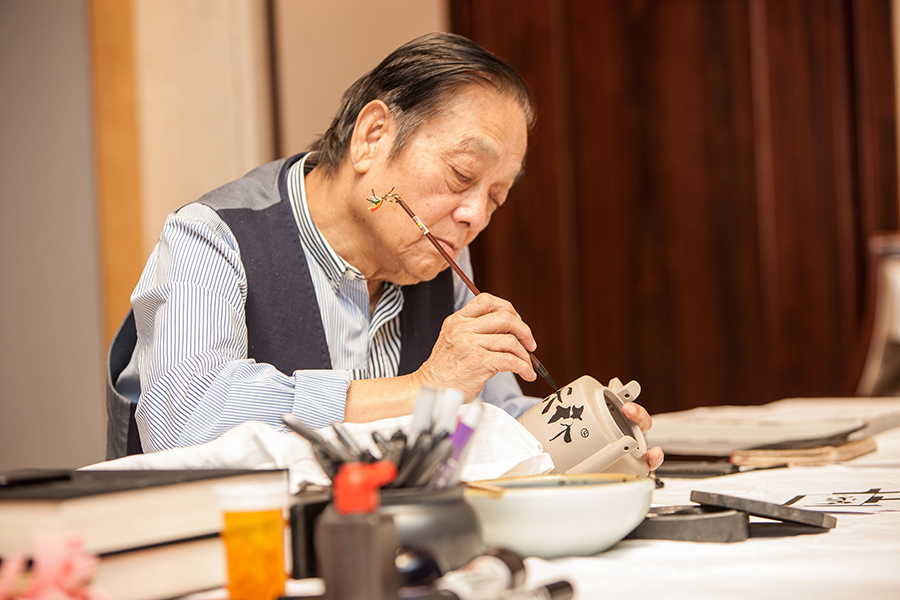
Han Meilin
Introduction
Han Meilin is a prolific and renowned Chinese artist, celebrated for his diverse body of work that spans paintings, sculptures, graphic and product designs, and more. Born in 1936, Han has exhibited an incredible dedication to his craft, continuing to produce significant works well into his later years. Among his most notable contributions are the Fuwa mascots for the 2008 Summer Olympics in Beijing, which exemplify his ability to blend traditional Chinese cultural elements with contemporary artistic expression. His works often draw on a variety of materials, including bronze, clay, wood, and silk, showcasing his versatility and mastery in different media.
Early Life and Education
Han Meilin was born in 1936 in Jinan, Shandong province, China. He showed an early interest in art and pursued formal education to hone his skills. His academic training was augmented by a genuine passion for folk art, which he later integrated into his work, connecting deeply with traditional Chinese culture and aesthetics.
Artistic Career
Initial Works
Han's initial works were characterized by a strong connection to Chinese cultural heritage. From early in his career, he displayed a keen interest in the traditional motifs and styles of Chinese folk art, which would become a recurring theme in his later works. His early sculptures and paintings reflected this influence, often incorporating elements from ancient Chinese myths and folklore. This period of his career was marked by experimentation and the development of a unique style that blended traditional Chinese aesthetics with modern artistic techniques.
Major Projects
Over the years, Han Meilin has undertaken numerous significant projects that have cemented his reputation as a leading artist in China. One of his most acclaimed projects was the creation of the Fuwa mascots for the 2008 Beijing Olympics, which became emblematic of modern Chinese culture on the world stage. Additionally, his work has included extensive series of paintings and sculptures that explore the themes of nature and the zodiac, reflecting his deep-seated commitment to integrating cultural motifs into his art. Notably, Han has also engaged in large-scale public art projects and exhibitions that have drawn national and international attention.
Style and Influences
Han Meilin's style is deeply influenced by traditional Chinese culture and folk art. He is known for his use of vibrant colors and dynamic compositions, often incorporating elements such as calligraphy and classical motifs. His work is also characterized by its diversity of materials, including bronze, silk, and wood, allowing him to explore different textures and forms. Han's influences are not limited to Chinese culture; his exposure to international art during his travels has also informed his approach, blending Eastern and Western artistic sensibilities in a harmonious and innovative manner.
Legacy and Impact
Han Meilin's legacy as an artist is profound, marked by his contributions to both the cultural heritage of China and the global art community. His dedication to integrating traditional motifs with contemporary art has inspired a new generation of artists to explore and reinterpret cultural narratives. As an influential figure in Chinese art, Han has played a crucial role in elevating the status of folk art within modern artistic discourse. His impact extends beyond the art world, as he continues to advocate for the preservation of intangible cultural heritage and the importance of cultural education. Through his work and mentorship, Han Meilin has left an indelible mark on the cultural landscape, both in China and beyond.








